How odd that the main story this morning was this:
Ian Tomlinson, the man who died at last week's G20 protests in London, was attacked from behind and thrown to the ground by a baton-wielding police officer in riot gear, dramatic footage obtained by the Guardian shows.
And by the afternoon we had this:
Counter-terrorist police arrested 10 young men across the north-west tonight in an operation hastily brought forward following an embarrassing security leak by a senior Scotland Yard commander.
Hmmm.
Showing posts with label The Guardian. Show all posts
Showing posts with label The Guardian. Show all posts
Wednesday, April 08, 2009
Filthy Fuzz
Saturday, August 23, 2008
Drug Companies Spend Millions on Direct Advertising
Following on from the attack by NICE on the drug industry in The Observer, The Guardian reveals today that the drug industry plows millions into persuading medical professionals to use their products. According to the report:
Drug companies are spending millions of pounds every year on all-expenses-paid trips to conferences around the world for doctors and other hospital staff, in what critics say is a massive marketing exercise dressed up as medical education.
The Guardian can reveal the scale of pharmaceutical company sponsorship following an examination of the registers of gifts and donations to doctors that all hospitals are required to keep. They show considerable largesse - from drug companies regularly picking up hefty bills for travel to international conferences in Europe, Asia and America, to specialist nurses' salaries, and weekly sandwich lunches for hospital staff training sessions.
Examples of the firms' hospitality include:
· Astra Zeneca paid £2,500 for a doctor at the Royal Bournemouth trust and £1,500 for a doctor at Sheffield teaching hospital to attend a cancer conference in Texas
· Sanofi-Aventis, the world's fourth biggest pharmaceutical company, paid for doctors at the Countess of Chester trust to go to conferences in Cape Town, New Orleans and Barcelona. At Gateshead trust, their reps gave a breakfast for 30 staff "to discuss drugs for the treatment of breast cancer". The trust's register records that "the donor was seeking to secure business".
· Roche spent £2,000 for an oncology consultant at Addenbrooke's hospital in Cambridge to go to a conference in May last year.
· GSK, the biggest British pharmaceutical company, paid £1,200 for a consultant at Sheffield teaching hospital to attend the 11th international congress of Parkinson's disease and movement disorders in Turkey last June.
· Companies have also been taking hospital staff to top football and rugby matches. Carillion, a public sector construction firm, spent £180 taking a senior manager at Milton Keynes trust to lunch and then a rugby match at Twickenham last August.
Fortunately, drug companies cannot advertise direct to the patient......yet. Only last year, drug companies and so-called 'patient groups' (funded by drugs companies funnily enough) lobbied the European parliament to relax the regulations on direct advertising. Should these patient groups be successful in battering NICE into submission, there is no doubt that the pressure would increase to allow the drug companies to advertise direct to the patient - a very dangerous prospect indeed when one considers the issues surrounding drugs such as Vioxx.
These are dangerous times in the medical world. Drug companies are scared of a decline in profits that will inevitably follow the expiration of their lucrative patents. This fear will drive them to ever ambitious attempts to secure their bottom line and patient groups are one of their biggest weapons. NICE must be allowed to carry out its work, no matter how hard it is for some patients to accept, or else we could find ourselves in a dangerous world where drugs are rushed to the market place after insufficient testing - leading to many more cases like Vioxx. NICE does a very difficult job, but it deserves everyone's support.
Friday, March 07, 2008
Pharmaceutical Accused of "Cheating" NHS
Here is the real problem facing the NHS. Corporations and doctors are doing their level best to destroy the NHS and create the right environment for it to be abolished and replaced with a more lucrative (for them anyway) system. The latest example of corporate attempts to damage public healthcare, concerns the activities of Reckitt Benckiser. The following is taken from The Guardian:
A drug company faces accusations of cheating the NHS by blocking a generic version of Gaviscon, the lucrative treatment for indigestion.
Internal documents leaked from Reckitt Benckiser reveal the existence of Project Eric, a secret plan by the company to manipulate doctors and regulators.
Gaviscon is one of Britain's most common remedies, prescribed in large quantities to people with heartburn. It costs little to produce but its high price makes millions for its Hull-based manufacturer. Although Gaviscon has been out of patent for almost 10 years, a cheap generic version wanted by the government has never been developed. Such a drug could have saved the NHS up to £40m.
The leaked documents reveal in detail how the company blocked the generic version. It is a tactic known in the pharmaceuticals business as "evergreening".
The company says the memos were "inappropriate" and did not reflect Reckitt's eventual actions.
Extracts, due to be broadcast tonight on BBC Newsnight, disclose Reckitt's plan to manipulate regulators on supposed safety grounds, threaten legal challenges and spin out procedures.
Generic drugs are a real threat to the major pharmaceuticals. When a patent on a drug expires, they no longer have a monopoly on the market, this allows generic equivalents to be produced at a cheaper cost (without affecting quality). Cheaper generics = loss of business for pharmaceuticals. It also means massive financial savings for the NHS which can then be plowed into life saving equipment, or better paid nurses and medical staff. Of course, the more the big corporations can extract from the NHS, the more damage it does to our system of healthcare, paving the way for a system based on insurance that would penalise the poorest citizens.
There is a way that all of us can take action regarding this issue. Doctors are often persuaded to prescribe branded drugs by the big pharmaceuticals, rather than the cheaper generic versions. As I have said above, this costs the NHS huge sums of money unnecessarily. So, next time you get a prescription from your doctor, ask that s/he prescribes the name of the drug rather than the brand name. When taking your prescription along to a pharmacy, they are obliged to dispense the generic version and hence save the NHS lots of money (not to mention making you feel good about yourself for being so conscientious). The big pharmaceuticals may not like it, but what is more important, universal healthcare or corporate profit?
Monday, March 03, 2008
Iain Dale - The Blogging Equivalent of The Emperor's New Clothes
I've never had much time for Iain Dale. He always seemed to be such a smug Tory bastard. That and the fact that he seemed to have nominated himself as spokesperson for UK political bloggers (not to mention that he is the very embodiment of all I hate round my neck of the woods). Quite simply, the rise of Dale has meant that a fall was inevitable and at some point people would realise his grasp on politics is weak to say the least. Hence his contribution to Comment is Free:
Yes they can?
Yes, this piece was an attempt by Dale to draw some kind of parallel between Cameron and Obama. Now, I would be the first to admit that there is little real difference between any of the four major parties split between the US and the UK, but this smacks of desperation somewhat (nothing to do with the Tories failing to capitalise on Labour's misfortunes??). Perhaps, with articles such as this, Dale might finally be found out.
Even more interestingly, after receiving a well deserved ridiculing from readers of CiF, Dale posted the following on his website:
Oh dear, I seem to have upset the esteemed readers of COMMENT IS FREE. Last week, my Telegraph column was supposed to have been about what David Cameron can learn from Barack Obama. Sadly, it got overtaken by events and I was asked to write about Andrew Lansley instead. Anyway, rather than let a provocative column go to waste, I thought what better use to make of it than to wind up the Obama supporting fanatics of The Guardian. Judging from the comments beneath the article, I succeeded beyond my wildest dreams. Read the full column HERE.
Yes, seems rather like the response you would expect from a teenager doesn't it?? "Oh, I was only doing to wind them up." Indeed. Truly, Dale's blog is the very definition of the Emperor's new clothes.......and we can all see his winkle.
Thursday, February 28, 2008
Tesco - Every Little Hurts
Tesco must be scared. After yesterday's revelations in The Guardian, there are rumours that the corporate giant is considering suing the newspaper. Perhaps they are just pissed because they have been rumbled. Who knows?
Thursday, February 21, 2008
British Government Sought to Protect Relationship with Israel
This from The Guardian:
The full extent of government anxiety about the state of British-Israel relations can be exposed for the first time today in a secret document seen by the Guardian.
The document reveals how the Foreign Office successfully fought to keep secret any mention of Israel contained on the first draft of the controversial, now discredited Iraq weapons dossier. At the heart of it was nervousness at the top of government about any mention of Israel's nuclear arsenal in an official paper accusing Iraq of flouting the UN's authority on weapons of mass destruction.
The dossier was made public this week, but the Foreign Office succeeded before a tribunal in having the handwritten mention of Israel kept secret.
The FO never argued that the information would damage national security. The Guardian has seen the full text and a witness statement from a senior Foreign Office official, who argued behind closed doors that any public mention of the candid reference would seriously damage UK/Israeli relations. In the statement, he reveals that in the past five years there have been 10 substantial incidents and 20 more minor ones relating to Israeli concerns about attitudes to their government within Whitehall.
The Information Tribunal, which adjudicates on disputes involving the Freedom of Information Act, agreed to remove the single reference to Israel when it ordered the release of the draft of the Iraqi weapons dossier written by John Williams, the FO's chief information officer at the time.
Along with unfavourable references to the US and Japan, the reference to Israel was written in the margin by someone commenting on the opening paragraph of the Williams draft. It was written against the claim that "no other country [apart from Iraq] has flouted the United Nations' authority so brazenly in pursuit of weapons of mass destruction".
This comes on the back of the 'revelation' that the UK government put the interests of the US government before the interests of UK citizens, the failure of Scotland Yard to arrest an alleged war criminal and the ongoing BAE scandal. All of this begs the question, when are we going to stop allowing other countries to dictate to us? When are we going to stick two fingers up to the Saudis, the Americans and the Israelis and determine out own course of action? When are we going to stop being controlled by the interests of others? I for one won't be holding my breath.
Tuesday, February 12, 2008
Government in the Pay of Big Business
Proof, if proof be need be, that New Labour just lurve the filthy lucre:
They are among Britain's wealthiest businessmen, with access to the heart of Downing Street. Yet little has been known about the elite group of multinational chairmen, or exactly what they talk about during their breakfast meetings with the prime minister. Until now, that is.
Downing Street documents disclosed to the Guardian reveal how the secretive lobbying group, which consists of the heads of Britain's most powerful corporations, including BP, Unilever, HSBC, Shell and British American Tobacco (BAT), have used their private access to protect the pensions of the ultra-rich.
The exclusive club, known as the multi-national chairmen's group, consists of fewer than 10 executives. Its members are invited to Downing Street to tell the prime minister how they believe government policies are affecting international corporations.
Downing Street has been forced to release the prime ministerial documents after a two-year battle over freedom of information. They show the executives:
· outmanoeuvred Gordon Brown, then chancellor, to shield "fat cat" pensions from his proposals to tax them more heavily;
· wanted Tony Blair, then prime minister, to lobby George Bush to treat corporations more favourably in return for supporting the invasion of Iraq;
· and lobbied for less "burdensome" red tape so multinational corporations would continue basing themselves in Britain.
And they call this a Labour government.
Sunday, February 10, 2008
Rowan Williams, Sharia Law and a Storm in a Teacup
Predictably there has been a media storm over Rowan Williams' comments regarding Sharia law and the UK legal system. The word 'Sharia' has far too many connotations for it to be used in a rational, sensible debate. Thanks in no small part to the tabloid press, Sharia has become overtly linked to hand chopping, beheadings and stonings. Of course, the reality is that this isn't necessarily the case. The practices in Saudi Arabia, for example, are more to do with the despotic regime and its own particular interpretation of Sharia than Sharia law itself. Besides, this was not the point that Williams was actually trying to make. He actually made reference to civil practices, rather than the medieval criminal justice that is handed down in some Islamic countries.
What Williams was actually suggesting was that elements of Sharia should be acceptable under UK law. He argued that UK law should always take precedence in any legal dispute but, where Sharia and UK law are not directly in conflict, recourse to Sharia should be an acceptable alternative for the Muslim population. This would, for example, allow Sharia Law Councils to deal with divorce and other civil disputes and the outcomes would be recognised by English law. There is no real revolutionary concept behind this. There is no real threat to 'our way of life', whatever that might mean. Jewish citizens of the UK already have such a system in place where they can refer to a recognised court for civil actions via the Beth Din. It is surely possible to having a working comparable for those of Islamic faith.
Perhaps the oddests side of this whole debate has been the typical reaction from the reactionary right. They have been very quick to rubbish Williams and his arguments whilst demonstrating a compete ignorance of his arguments. Just this morning I saw two laughable attempts by a pair of jokers on this morning's Big Question (I know, shite programme, shouldn't expect anything less). This morning, both Kelvin McKenzie and Douglas Murray (I believe the collective word for such people is cunts) spewed utter vile straight to camera. Both of them used particularly hilarious attempts at attacking Williams and the concept of Sharia. What makes there arguments particularly amusing is the methods by which they attacke Sharia. Suddenly, out of the blue, McKenzie has become concerned with equal gender rights and human rights abuses. Suddenly, he is concerned with how women are treated and how criminals are punished. Laugh?? I nearly coughed up my internal organs. This is a man who presided over The Sun for fuck's sake, he didn't seem to bothered about gender equality back then did he?? Not to mention is repeated calls to 'string up' various criminals. What a joke this man really is. Furthermore, he claimed that if Christians were living in an Islamic country, they would have to live by Islamic law and deal with the consequences. Wrong. As Jason Burke points out in today's Observer:
Elsewhere accommodations have been found, often based on original settlements by colonial powers. So in India, which does not have a state religion, 140 million Muslims, like other communities, have retained their own civil laws governing marriages, divorces, deaths, births and inheritance. In overwhelmingly Muslim majority Egypt, religious minorities are governed under separate personal status laws and courts. The Coptic Christian minority in the country marry under Christian law and foreigners marry under the laws of their countries of origin.
Yes, in an Islamic country Christians can marry under Christian law. They are not forced to accept Islamic law as the be all and end all. As for Douglas 'Smug Arse' Murray, he came out with a real pearl. Apparently, elements of Sharia should not be permitted as we shouldn't accept laws that originate from a 'fictional book'. Whilst I agree that this should not be the case, aren't our current laws based on Christian law and therefore derive from a 'fictional book'??? Oh sorry Douggie, did that just shoot down your pathetic argument??
Ooops, I went off on a bit of a tangent then. Anyway, whatever McKenzie, Murray and the other neo-fascist conservatives argue is entirely irrelevant. This was not the argument that was set out. The argument revolved around civil disputes and the best way of handling them, not some ridiculous artificial argument about stonings and mutations. We already have some acceptance of Islamic modes of living within the UK, particularly in regard to halal meat and Sharia-compliant mortgages. Personally, I am opposed to religion having any role within the law whatsoever. However, it seems absurd that Muslims cannot have the same rights bestowed upon them as with other religions. If two Muslims (with emphasis on the two - both have to want it) wish to deal with their personal disputes with a Sharia court, let them. I really couldn't care less. If it is good enough for Jews it is good enough for Muslims. As long as English law is primary (and the likelihood of some interpretations of Sharia ever being recognised is slim to say the least - not least because it would lead to our withdrawal from the EU), there is no problem. Rowan Williams' only fault is in believing that the public were ready for a mature debate on the issues. With the press firmly anti anything Islamic, the chances of a rational debate where zero. Particularly when shits like Murray and McKenzie continue to draw breath.
Incidentally, there was a fascinating article in The Guardian a while back regarding a Sharia Law Council operating in the UK. It proved quite enlightening on what the system actually means in practice. I would heartily recommend reading it here.
You can also read the .pdf file of the speech given by Williams here.
Oh yes, apologies for the McKenzie/Murray rant. I had a belly full this morning what with Amanda Platell, Kelvin McKenzie and Douglas Murray all on BBC1 within 60mins. That is more than one person can handle without public warnings by the BBC beforehand.
Monday, December 03, 2007
Venezuela and the Referendum - BBC Just Not Right-Wing Enough
So, there we have it, Hugo Chavez did not win the referendum for his constitutional reforms. The world has not ended. Chavez has accepted the results of the vote with good grace. Still, there is plenty for the mainstream media to crow about, and one of the culprits has the dubious pleasure of being both hyper-critical of Hugo Chavez (see here) as well as being perceived as a left-wing organisation. Strange times indeed. So let's take a look at the output on Venezuela by this fabled left-wing institution shall we?
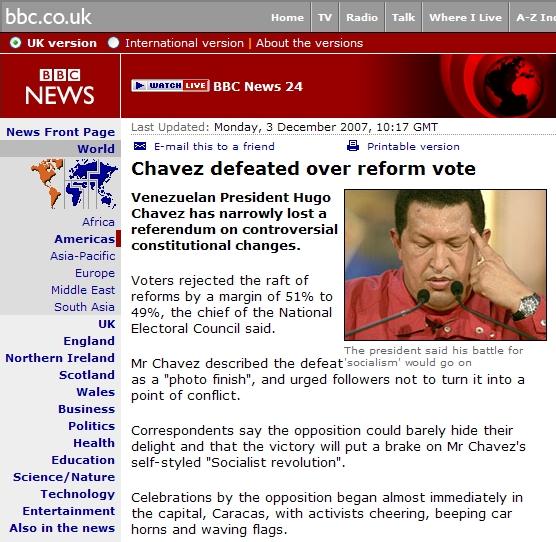 So far, so innocuous. But it is when examining the detail that the true message shines through like a beacon. Not much further down comes the first telling quote:
 Yes, somehow those words are a direct reference to his attempted coup aren't they? I'm not sure why this is particularly relevant. Yes they failed, yes he is obviously going to present it to the public again at some point in the near future. But the question remains, why refer to a coup attempt 15 years ago? Then it gets worse:
The inference clearing being that, through this referendum (and therein lies the key - a referendum), Chavez was aiming to establish a dictatorship. This is on the basis that he wanted to stand an unlimited number of times for President, a bit like the UK. And it also refers to the oft-repeated claims about him being in power until 2050 (more on that later).
Then, in case you didn't get the point drummed into you:

Have you got it yet?? Chavez=dictatorship according to this 'left-wing' media outlet. So there we go, the BBC recipe for a left-wing viewpoint. Sprinkle liberally with references to dictatorships and militant tendencies and allow to stand. Brilliant. These guys must be immensely clever to hide a left-wing ideology in their writings. Either that, or there are a lot of very dim-witted people out there - you decide.
But it's not just the BBC, oh no. The Guardian have let a couple of things slip over this issue. Take this reference on their website:
There's that 2050 reference again, hinting at the possibility of a Castro style dictatorship. Mmmm. This whole 2050 thing was purely hypothetical. It creates the impression that Chavez would hang on to power until 2050 when the reality is that, if Chavez were to stand for every election, he would rely on the will of the people. He has never indicated that elections would be abolished and he would remain in power until 2050. It was an entirely hypothetical proposition.
As for The Guardian, they could have chosen to headline the fact that Chavez gave people the right to vote on such an amendment, true democracy in action. But then this is something we are hardly likely to see encouraged in the UK and the US. People having their say?? What a terrible notion. They also referenced Manuel Rosales (a man who supported the US backed coup) in their paper, but wisely edited it out of the online version.
And what is the situation in Venezuela? Well, Chavez has accepted the result and told his supporters to respect the outcome. Hardly the sign of a power mad totalitarian dictator is it? No matter what the media might have you believe.
Monday, November 26, 2007
Bloody Guardian, Why Do You Spite Me So??
Sometimes The Guardian seems intent on spiting me. I write a letter to The Guardian complaining about a full page advertisement for Total (who are part of the problem in Burma) and I get completely ignored. John bloody Pilger writes a letter about an advertising feature on Burma and he gets published. I mean, what's he got that I haven't?? If only I was a well respected film maker and journalist. Aaahhh, one can dream......
Wednesday, November 07, 2007
Terrorist Claims Are Self-Defeating
I have to admit I am not normally a Simon Jenkins fan, but his column in The Guardian today certainly hit the nail on the head. Here's a little taster:
The essence of a secret service used to be secrecy, including of its methods and achievements. Otherwise it is just a branch of the police. In the early days of "avowal" in the 1980s, the heads of MI5 and MI6 would invite journalists to tell them how to go about handling publicity. One, Stella Rimington, was obsessed with how she might do on Any Questions? Others fancied themselves as M lookalikes. The only advice that made them miserable was that they should stay secret. "How," one retorted, "are we ever to lobby for our budgets when the cold war is over?" The answer of both MI5's Evans and MI6's John Scarlett is to join the fear factory.
In 2002-03, before the Iraq war, the security service supplied the Cabinet Office with a weekly catalogue of "terror fears" - anthrax, smallpox, sarin, dirty nuclear devices and a Christmas bombing campaign - to soften public opinion for the war. It was MI5's answer to MI6's "weapons of mass destruction", and was the same drivel.
There can be only two results from this abuse of publicity. One is that the public demotes such scares to wolf-crying and treats them as background noise. The other is that, as all scare stories stereotype communities, the host nation distances itself from whatever group allegedly harbours the threat. The latter in turn retreats and denies the police the intelligence required for public safety. In other words, speeches such as those from the head of MI5 are wholly self-defeating.
Stupefying sums of money are being devoted to warding off a threat to life and limb which, I suspect, is far less than was posed by the IRA in the 1970s and 1980s. The IRA succeeded in evading the police, killing large numbers of people and destroying property with grim regularity. It did so with the intention of changing policy and securing the release of murderers and criminals. What it did not do was curb British liberties.
Al-Qaida has killed fewer Britons but induced politicians to curb more liberties. It remains so murky that the security services grab at the epithet "an al-Qaida-linked organisation" to imply they are up against some vast global mafia, to excuse any intelligence failure and justify any increased budget.
I couldn't have summed it up better myself. This perhaps explains why Mr Jenkins writes for The Guardian and I write on a wee blog. Ah, such is my fate.
Monday, November 05, 2007
UK and US Back Musharraf in Private
No surprise given that President Musharraf is the good dictator favoured by the West. It has emerged in The Guardian today that there is a fair chance that the US and the UK gave Musharraf clearance to announce emergency rule. From The Guardian:
A Musharraf aide told the Guardian that the Pakistani president had "satisfied" objections raised by Mr Brown during the conversation. "There was pressure from the US and Britain in the beginning. But later on, when the government gave them the detail that elections will be held on time, and the president will take off his uniform, they did not have any objections," the official said, on condition of anonymity. A Foreign Office official insisted "no consent was implied or given".
Of course, the Foreign Office are hardly likely to admit this, but the truth is that the West relies rather heavily on Musharraf, particularly in relation to the so-called 'War on Terror' and the war in Afghanistan.
Despite claims in The Guardian that the West has issued an ultimatum to Musharraf, officials in the US are taking a slightly different stance. One senior official responsible for policy matters regarding Pakistan has claimed:
"The problem is we have a war in Afghanistan, and Pakistan is a coalition partner. We have troops on the ground in Afghanistan, and it's hard to have a good outcome there if Pakistan is not cooperating."
He also added:
“I think Musharraf has rolled the dice. He believes that the odds are in his favor, that the public is going to accept this and that the public response to this is containable without a lot of violence. But it’s a risk and we don’t know what the public reaction will be.”
And there is the problem for the US and the UK. they have invested a great deal in Musharraf in their attempts to deal with the situation in the northwest of Pakistan and are unlikely to do anything unless things escalate. Behind closed doors that US and UK will be hoping that is not another Burma, because they don't want to have to take any action in Pakistan, or face increased public pressure to do so. No, they will sit tight, keep their fingers crossed and ride this one out. After all, Musharraf is the good dictator
Thursday, November 01, 2007
The Madrid Bombing Verdict and the Disdain of the Establishment
The establishment have really had it in for the Spanish ever since their apparent 'craven' surrender to the terrorists after the Madrid bombings. That they are so dismissive of the Spanish for their bravery in standing up to their lying government and kicking them out, speaks volumes of the true nature of democracy in the West. I have written about this at length in the past (I was in the country at the time), but the judgement of the Spanish court yesterday brought all the old establishment disdain out into the public once more.
The Times (the chosen paper of the establishment) was, of course, at the forefront of the attacks on the Spanish legal system. One look at their piece told you all you needed to know:
191 dead, thousands of victims - but the ‘mastermind’ is cleared
The accused mastermind of Europe’s worst Islamist terrorist attack was cleared of all charges along with six others yesterday in a shock judgment that angered victims.
After hitting the reader with the initial 'What the f*&k opening', purely designed to make you spit out your breakfast with disgust upon reading it, it then adds:
Twenty-one others were convicted of playing a role in the 2004 Madrid train bombings, though many of them on much lesser charges than the prosecution had sought.
Oh, so 21 were convicted?? That's pretty impressive. We have hardly convicted anyone. But, before you digest that:
Family members of the 191 people killed and 1,800 injured expressed astonishment, branding the sentences as lenient and feeble, and vowing to appeal.
"Bloody judiciary. Full of softy liberals."
"Didn't it say something about 21 convictions?"
"Brrrr, yes, but......"
Pilar Manjón, who heads the largest association of victims, said: “I don’t like to see murderers walk free.” She lost her 20-year-old son when ten bombs packed into sports bags and detonated by mobile phone ripped through four commuter trains.
"There, you see? Murderers walking free. Bloody disgrace."
"Yes, but the 21 convictions??"
"21 what? You lefties are all the same. These murderers walk free and all you can keep banging on about is a trifling 21 convictions."
It's interesting how it works. First the set-up, guaranteed to shock all those bowler hatted types eating their cornflakes. Then the tiny piece of fact that drops the anger down a notch, which is then quickly forgotten as the apocalyptic rage is cranked up several notches with talk of murderers being let off and the poor families that were affected. In the first four paragraphs, three are clearly designed to make you rage, while the other one is hidden amongst the anger so that it is broadly ignored by the red-faced establishment stooges settling down to their daily fix. And just in case you fail to grasp the subtle subtext of the piece, it blazes across the headline:
191 dead, thousands of victims - but the ‘mastermind’ is cleared
Well, that's clear then.
Thankfully, The Guardian's leader (a paper that has been as guilty of defending the establishment line as other papers) puts the trial into its proper perspective:
Nevertheless Spain's experience challenges Britain to do these things better than it has done so far. Our systems may not be the same - and the Spanish police also had some lucky breaks in their post-Madrid investigations. But there are important parallels too. Spain has deep historic links with the Islamic world, as we do. Spain had built up a strong corpus of laws during the Eta terrorist years, just as we did during the IRA ones. Yet, with all the provisos, Spain has managed to secure lawful convictions under these pre-existing laws without either legislative hyperactivity or threatening to do away with essential liberties. Suspects in Spain are rarely held for more than a maximum of 10 days without charge, compared with Britain's already draconian 28 days, which Gordon Brown now wants to increase. There are many differences between our situations, but Britain needs to learn a Spanish lesson.
Now the Spanish system is not perfect (far from it), but they have certainly dealt with this situation in a far better way than we have. Perhaps that is what really sticks in the throat of the establishment. Here are a people who bravely marched on the streets of every town and city in Spain in the aftermath of a horrendous terrorist attack to show their unity and strength. A people who had the temerity to kick out a government that lied about the bombings in the days leading up to the election. A people who dared to utilise their democratic rights. Clearly such people are to be condemned. Democracy should work for the establishment, not against it, right?
Wednesday, October 17, 2007
The BBC - A Left-Wing Organisation?
Right, I am confused. For some time now, I have been led to believe that the BBC was run by a bunch of lefties, determined to eradicate the right-wing and turn the UK into some kind of socialist agenda. For months I have been led to believe that the BBC is pumping out a steady stream of leftie propaganda. For months I have been convinced that the BBC is part of some vast left-wing conspiracy conducted by the mainstream media. And then I switch on BBC Breakfast this morning and, later in the day, I catch this on their website:
Migration 'causes pressure in UK'
Impartial?? Mmmmmm. Thinking I might have got this all wrong, I read on:
Almost every UK region has difficulties in housing, health, education and crime because of increased migration, according to an official report.
The findings are contained in a report drawn up to advise ministers on the social impact of immigration.
The Home Office's Migration Impacts Forum is meeting to discuss the effect of eastern European workers.
On Tuesday, ministers published a review of research showing "clear benefits" to the British economy.
The forum, which sits alongside a separate economist-led body, gathers reports on challenges raised by immigration across the country.
In the opening 16 paragraphs, the underlined passage is the only positive comment on the report. Compare that to the reporting in The Guardian:
Migrants - the verdict: hardworking and skilled but with social problems in tow
The first official government study of the economic impact of the biggest wave of migration to Britain in recent years reaches an overwhelmingly beneficial verdict.
"In recent years migrants have made a more positive contribution to the public finances than native workers; have often been highly skilled and accordingly captured higher labour market rewards," concludes the joint Treasury, Home Office and Work and Pensions study.
"They have very little discernible negative impact on labour market outcomes for native workers."
But the Home Office also published the initial findings last night of regional "soundings" of the impact of east European migrants in Britain. It revealed that in seven out of eight regions they have increased pressure on housing and more than half have seen a rise in crime, health and housing problems.
See what they did there?? The Guardian, although acknowledging the supposed negative impact (although this is mainly down to anecdotal evidence), preferred to focus on the positive aspect of the story. The BBC on the other hand, the so-called defender of a multi-cultural society, preferred to focus on the negative impact of immigration, like the TV version of the Daily Mail. Hardly indicative of a organisation dominated by a left-wing agenda.
Thursday, October 11, 2007
Burma - Hotels Feeling The Heat
After constant pressure by activists across the globe, the pressure is really starting to tell on those that support the military junta in Burma. This from The Guardian:
Last month's pro-democracy protests in Burma and the junta's ruthless and bloody crackdown have hit tourism hard, with some hotels slashing prices by 80% to try to attract visitors, industry insiders said.
"There has been a steep drop in foreign arrivals - both businessmen and tourists - since the protests reached a climax in the last week of September," a manager at a Rangoon-based travel agency said yesterday. Most hotels had more than halved their rates, the manager said, but occupancy levels were below break-even point, a reflection of the outrage at last month's crackdown on monks and civilians in which at least 10 people were killed.
According to the Myanmar Times, a semi-official business weekly, the Savoy Hotel has axed its prices to just $20 (£9.80) a night, compared with a normal high season rate of $110.
"Business has been very bad. Most of us have been out of a job for weeks," said one English-speaking tour guide. "It is not just because of the seasonal factor. We had a lot of cancellations. "
Even before the unrest tourism was in a parlous state, partly due to activists' calls for a boycott in order to keep tourist dollars out of the generals' pockets. Burma says it had 192,000 tourists in the year to March. By contrast, neighbouring Thailand expects about 13 million visitors this year, and even war-scarred Cambodia is aiming for 2 million.
Airlines have also been hit by the crisis. Domestic flight schedules had to be altered because of curfews imposed on Rangoon and Mandalay, and even unaffected flights are half-empty. A businessman who flew in from Singapore last week on an Air Bagan Airbus capable of carrying more than 200 passengers said there were only two dozen people on board.
If there is an hope that the military regime will collapse, the current trends need to be continued. Many of these companies hide behind their claims of helping the poor in Burma. However, given the amount of money that this generates for the junta, they are equally complicit in the murderous actions of this military regime. Only with the continuation of this pressure can the people of Burma truly be freed.
Monday, October 08, 2007
Abortion in Nicaragua - A Warning
With the election of Daniel Ortega, there was much to be positive about the future of Nicaragua. At last, there was a leader that responded to the needs of the poor, rather than pandering to the rich, American loving elites. Certainly there have been encouraging developments since his election, in part due to the development of close ties with Chavez, Morales et al. However, not everything is rosy in Nicaragua. Last November it became a crime for a woman to have an abortion, even if her own life was at risk. Since the law was passed, nearly 100 women have died. Rory Carroll has written a heart-breaking account in The Guardian of the fight to have the law changed in Nicaragua. Here's an extract:
María de Jesús González was a practical woman. A very poor single mother, the 28-year-old's home was a shack on a mountain near the town of Ocotal in Nicaragua. She made the best of it. The shack was spotless, the children scrubbed. She earned money by washing clothes in the river and making and selling tortillas.
That was not quite enough to feed her four young children and her elderly mother, so every few months González caught a bus to Managua, the capital, and slaved for a week washing and ironing clothes. The pay was three times better, about £2.60 a day, and by staying with two aunts she cut her costs. She would return to her hamlet with a little nest-egg in her purse. She bought herself one treat - a pair of red shoes - but she would leave them with her family in Managua, as they were no good on the mountain trails she had to go up to get home.
During a visit to Managua in February she felt unwell and visited a hospital. The news was devastating. She was pregnant - and it was ectopic, meaning the foetus was growing outside the womb and not viable. The longer González remained pregnant, the greater the risk of rupture, haemorrhaging and death.
What González did next was - when you understand what life in Nicaragua is like these days - utterly rational. She walked out of the hospital, past the obstetrics and gynaecological ward, past the clinics and pharmacies lining the avenues, packed her bag, kissed her aunts goodbye, and caught a bus back to her village. She summoned two neighbouring women - traditional healers - and requested that they terminate the pregnancy in her shack. Without anaesthetic or proper instruments it was more akin to mutilation than surgery, but González insisted. The haemhorraging was intense, and the agony can only be imagined. It was in vain. Maria died. "We heard there was a lot of blood, a lot of pain," says Esperanza Zeledon, 52, one of the Managua aunts.
This is just one example of the butchery that has emerged in Nicaragua since the passing of this law. A further 81 women were victim to similar circumstances as Maria. If nothing else, these heart-breaking stories emphasise the consequences of any action to take away the right to abortion. It is a right that is worth protecting.
Thursday, September 20, 2007
Seumas Milne - Muslims Are Under Attack
Fascinating article by Seumas Milne in today's Guardian about the witch hunt being conducted by the mainstream media.
Britons are now more suspicious of Muslims than are Americans or citizens of any other major western European country, including France. According to an international Harris poll last month, nearly 30% of British people believe it's impossible to be both a Muslim and a Briton (compared with 14% who think you can't be French and a Muslim); 38% think the presence of Muslims in the country is a threat to national security (compared with 21% in the US); and 46% believe that Muslims have too much political power in Britain, far above the level of any other surveyed country. You might think that these findings, reported in the Financial Times, would have been the occasion for some soul-searching about where British society is going, the state of community relations, and a new self-restraint in the way Muslim stories are covered in the media.
Not a bit of it. The fact that a large minority of Britons have some of the most Islamophobic attitudes in the western world has passed without comment. Instead, we have since been treated to a renewed barrage of lurid and hostile stories about Muslims which can only have further inflamed anti-Muslim opinion and the community's own sense of being under permanent siege. This isn't just a problem of hate-filled tabloid rants, such as the Express's denunciation of Muslims' "alien and threatening outfits", or Richard Littlejohn's Muslim-baiting in the Mail. For the past three weeks, there has been a stream of hostile coverage in the heavyweight press and on TV current affairs programmes.
This week it is was an hour-long Channel 4 Dispatches about attacks on Muslim converts to Christianity; last week it was the BBC Newsnight programme's 20-minute interview with the latest defector from the non-violent Islamist party Hizb ut-Tahrir; the week before that it was a Newsnight special on radical Islamist books in east London libraries, complete with sinister music and a round-table debate. The same week there was a Times front-page splash about the "hardline takeover of British mosques", focused on the deeply conservative Deobandi religious movement which has long had a strong presence among British Muslims of Pakistani origin. For both Newsnight programmes, it was apparently felt that Patrick Mercer - the Tory MP sacked by David Cameron for making racially inflammatory remarks and appointed a security adviser by Gordon Brown - was the ideal person to comment on Muslim issues. Meanwhile, the novelist Martin Amis denounced "liberal relativist appeasers" of a "racist, misogynist, homophobic, totalitarian, inquisitorial, imperialist and genocidal" doctrine.
He also adds:
.......and Crown Prosecution Service figures show that 82% of convictions for identified religiously aggravated offences last year involved attacks on Muslims.
A reader on CiF adds an extra bit of context regarding this statistic:
"A total of 51 religiously aggravated charges were prosecuted, an increase of 18.6 per cent on 2004-05. Nearly 70 per cent of these cases were prosecuted in the magistrates' courts with religiously aggravated public order offences accounting for almost half the charges.The actual or perceived religion of the victim was not known in 21 out of 43 cases. In the 22 known cases, 18 victims were identified as Muslim, three as Christian and one as Sikh. The data covers the period following 7 July 2005 London bombings and the number of victims identified as Muslim throughout the whole of last year was 81.8 per cent, a rise of five per cent on the previous"
The media (and society as a whole) is on the offensive against a religious minority. Souhnd familiar?
Thursday, August 16, 2007
Iran and Pakistan - The American Contradiction
Sometimes even The Guardian disappoints me. The US has been upping the ante against Iran with its latest threat to class the Iranian Revolutionary Guard as a terrorist organisation. Not withstanding the fact that this would make it easier to portray Iran as a state harboring terrorists (and thus, under the Bu$h doctrine, make it easier to launch an attack), this move is an interesting contradiction with the situation in Pakistan, and its relationship with America.
One of the pretexts for this move by the US, is that Iran has been fomenting violence in neighboring Afghanistan. On page 13, The Guardian makes plain the government view on the troubles via an interview with Des Browne. Browne made the following statement:
"I have no doubt - because we have uncovered evidence - of weapons coming in through narco-trafficking routes, supplying weapons to the Taliban. I have reason to believe the Taliban go to Tehran for training."
He also accuses Iran of:
"backing every horse in the race."
This is all part of the Iran interfering with its neighbours pitch that the Western powers are spreading around. However, turn to page 26 and we find an interesting little story, buried away near the back of the international section:
The Pakistani government gave substantial military support to the Taliban in the years leading up to the September 11 attacks, sending arms and soldiers to fight alongside the militant Afghan movement, according to newly released US official documents.
Islamabad has acknowledged diplomatic and economic links with the Taliban but has denied direct military support. The US intelligence and state department documents, released under the country's freedom of information act, show that Washington believed otherwise.
The suspicion has lingered that some elements of Pakistani intelligence are still protecting the Taliban and its al-Qaida allies in the autonomous tribal areas along the Afghan border. US officials have warned they might take direct military action without Islamabad's approval.
So, while Iran is considered a hostile nation due to alleged activities in Afghanistan, Pakistan is considered a friend in similar circumstances. So when is the United States going to proclaim MQM as a terrorist organisation? I guess never as right-wing groups remain infatuated with right-wing military dictators.
Thursday, June 14, 2007
Sharia Law in the UK
Interesting piece in The Guardian today, sure to enrage the Muslim hating right, about the reality of Sharia in the UK. I'm guessing Melanie Phillips' head nearly exploded over this one. Here's a quick extract:
In the back room of a converted corner shop in east London, Sheikh Maulana Abu Sayeed is trying to save another marriage. He stretches across his desk and gently holds the hand of a young man with five o'clock shadow, whose eyes are red and swollen from crying. For more than an hour the man has been pleading with Sayeed to ask his ex-wife to give him a second chance. And for more than an hour, Sayeed has been quietly telling him that if his ex-wife does not want him back, there is nothing he can do. As the fraught meeting continues next door, one of Sayeed's colleagues at the Islamic Sharia Council in Leyton explains with a shrug, "He has come to us to ask for help, but if the woman is adamant and she doesn't want to reunite, what can we do?"
The image of a Muslim man pleading with his imam for a second chance with his wife, only to be told that it is his wife's decision, is not what most people would expect from a sharia court. But his case is typical of hundreds each year dealt with by a group of scholars who provide judgments on sharia law for Muslims across the country.
Read the full article here.
Monday, May 21, 2007
Drug Firms Fighting to Overturn Advertising Ban
Once again, the big pharma companies are flexing their muscles and threatening the EU unless it eases legislation on the industry. They are desperate to advertise their 'products' direct to the patient and they have drawn the support of various patient groups (which are in turn funded by the drug companies themselves) who believe that they have a right to choose which medication they are prescribed. We are heading towards very dangerous waters indeed. Although the idea of choice sounds wonderful, this is one of those cases where there is no such thing as 'choice', at least not an informed choice.I have two fundamental problems with the very notion of direct advertising borne out of my own experience with the drug industry. The first is cost, the second is knowledge. Allow me to explain.
First of all, let me paint you a picture of the current situation regarding advertising medicines and the subsequent costs. For some time now, drug companies have been able to advertise OTC (or 'over the counter') medicines in various forms. It is not unusual to see adverts for Calpol, Nurofen, Hedex on the television on an average day. One of the strongest OTC brands on the market is Panadol. Now, Panadol is essentially paracetamol. That's it, nothing more. The problem is that it has such a high level of recognition amongst the general public, many people ask for Panadol at the chemists for their headaches, colds etc. A pack of 16 Panadol tablets costs approximately £1.39 the cost of paracetamol (the active ingredient in Panadol) is substantially less than that. Nowadays, thanks to the 'wonders' of competition, you can pick up a pack of 32 paracetamol at your local chemists for approximately 65p. That is an amazing 74p difference, and you get twice as many tablets! And yet, they are exactly the same product. Only difference is, one is marketed as Panadol and one is marketed as a proprietary brand. And this, on a very small scale, is the problem that would be faced should the big pharmaceuticals get their way. POMs (or 'prescription only medications') are obviously far more expensive (in many cases) than OTCs. Imagine the difference in cost between a branded medicine and its generic equivalent. No matter that they are the same drug, the marketing campaign would ensure that a particular brand would stay in the patient's mind and encourage them to ask for that particular drug to be prescribed to them. This would clearly have vast consequences for the NHS. Whereas they would normally dispense the generic, cheaper drug, now they would have to dispense the more expensive branded drug. The cost to the NHS would be disastrous. But then, this is what the drug companies want anyway. The destruction of the NHS would ensure that their profits would reach previously unseen levels.
The other problem is the knowledge of the customer regarding the actual drugs themselves. I know many people think that they know everything there is to know about medication and various drug formulas. Well, I got new for you, you know jack shit. Why do you think doctors and pharmacists train for so long before they can prescribe or dispense these drugs? The general public only knows a fraction of the facts about the drugs they consume. However, it would be unfair to pin the blame for this solely on the consumer. Drug companies make it exceptionally hard for anyone to find out what the truth is about the drugs they manufacture, Even those who work in the health industry are not aware of all the facts about the drugs they issue. Take the case of Vioxx. The manufacturers Merck were found guilty of negligence in its
response to safety concerns about the painkilling drug. The reason for the safety concerns were because the drug wasn't fully tested. Imagine if Vioxx was backed by a huge advertising campaign. Just think how many people would have been affected if this was the case. This is where the problems begin. Even if the drug was properly tested, how could an average member of the public be able to disseminate complicated information about the drug trials and then make an informed choice? They can't. They will put their trust entirely in the hands of the drug companies. This is a very dangerous situation indeed. Doctors and pharmacists provide an important barrier between patient and drug company. The only people that can make judgements about the drugs we take are healthcare professionals (and even then they are still susceptible to financial inducements from the drug industry). I wouldn't have a clue about the effects of some of the POM medications that are on the market, and that's the way the drug companies like it. Our ignorance is their profit.
Make no mistake, a relaxation in the rules governing the marketing of POMs would have disastrous consequences. The NHS would be further crippled by the rise in the dispensing of branded drugs in favour of their generic equivalents. It is believed that the NHS could save more than £300m a year by prescribing generic over branded, imagine the consequences if the reverse were to happen. The result would be the final collapse of our national healthcare system. Furthermore, the inability for the patient to make an informed choice could also have disastrous consequences. Without having access to all the trial data, let alone be able to understand it, the patient would rely solely on the advice of the companies that produce the drugs. One thing is for certain, that are not going to put off potential customers, they have a business to run after all. In short, this move to ease regulations must be resisted at all costs. There is no telling how much long term damage this would do. The following is the conclusion of a report in the British Medical Journal about the 'Influence of direct to consumer pharmaceutical advertising and patients' requests on prescribing decisions':
Patients' requests for medicines are a powerful driver of prescribing decisions. In most cases physicians prescribed requested medicines but were often ambivalent about the choice of treatment. If physicians prescribe requested drugs despite personal reservations, sales may increase but appropriateness of prescribing may suffer. Concerns about the value of opening up the regulatory environment to permit direct to consumer advertising in the EU and Canada seem well justified.
Subscribe to:
Comment Feed (RSS)


 Posts
Posts

