Showing posts with label Chavez. Show all posts

Sunday, February 15, 2009

The Chavez Deceit

Once more, large sections of the media are representing the referendum in Venezuela in a very dubious light. The Observer's headline says much about the angle that they are taking:

Anti-Chávez lobby dares to hope for a last-ditch victory


The opening paragraph really underlines the standard Western view of Venezuela:

A ragtag coalition of university students, traditional elites and disillusioned "chavistas" will today try to end Hugo Chávez's dream of ruling Venezuela for life.

'Dream of ruling Venezuela for life'? That couches it in particularly disturbing terms. Do we talk of Gordon Brown or David Camerin dreaming of 'ruling for life'? Of course not. And yet there is little, if any, difference between the system being proposed in Venezuela and the system in the UK. Apart from one fundamental difference. The Venezuelan people are having a say in a change in the constitution. Can you imagine that happening in the UK? The idea would fill the political classes with dread.

One thing that characterises these reports about the situation in Venezuela, is the failure to put the opposition to Chavez into context. Quite often they are represented as respectable statesmen who are fighting to wrestle power away from an all too powerful President. What they fail to report is that many members of the opposition were deeply involved in the failed coup in 2002 that was backed by the Bu$h White House. These are not all democrats and respectable statesmen. Many of them are plotters and proxies for the interests of the United States. And yet, the opening quote in the Observer piece is from one of these fronts for the American government.

However, one of the most important quotes has been conveniently ignored:

"This is important for me as a human being and as a soldier in this fight.

"We'll recognize the result, whatever it is, once it is announced by the National Electoral Council."

Chavez swore last time that he would respect the result, and he did. What makes anyone think that this time it is any different?

Saturday, September 13, 2008

Bolivia, Venezuela - Coups in Waiting?

It certainly appears that whilst the public are distracted by moose shooting censorship lovers and the second coming, the US government is once more attempting a spot of covert regime change in South America. As RickB has already noted over at Ten Percent, both Venezuela and Bolivia have now expelled their American ambassadors as a result of apparent attempts by the American government to remove these governments from power. It has also emerged that the American government may have been supporting officers within the Venezuelan army who are hostile to Chavez. According to The Guardian, Chavez said:

'...several Venezuelan military officers had been detained following an investigation by his intelligence services. During his televised address he played a recording of purported conversations between the alleged conspirators.

Earlier, the defence minister, General Gustavo Rangel Briceño, and a pro-Chávez TV host, Mario Silva, named several senior officers from the navy, air force and national guard as suspects.'


Not content with supporting anti-government forces in Venezuela, the US government has further attempted to smear Chavez by once more linking him to the Colombian drug trade and the FARC. Again, from The Guardian:

Separately, the US treasury accused three members of Chávez's inner-circle of materially assisting the Revolutionary Armed Forces of Colombia (Farc), leftist guerrillas who traffick cocaine and are considered terrorists by the US and EU. Hugo Carvajal Barrios and Henry Rangel Silva are senior intelligence officials and Ramón Rodríguez Chacin was interior minister until this week when he unexpectedly resigned, citing personal reasons.

Venezuela's government acknowledges talking to Farc to negotiate hostage releases but denies funnelling weapons or drug money.

Visiting Britain this week, the US drugs czar, John Walters, repeated claims that Venezuela and Bolivia were taking over from Colombia in the export of cocaine.


It would be funny if it wasn't so serious. After all, the US government also play a key role in supporting terrorist organisations in Colombia. Despite Uribe's well documented links to human rights abuses, as well as his links to right-wing terrorists operating within his borders, the US government continues to fund his government to the hilt. If Chavez is guilty of aiding a 'terrorist organisation' in Colombia, Bush is equally guilty. And yet, in this world of inverted mirrors and perverse logic, Chavez is the threat and Bush is the solution. And if anyone thinks that Bush Terror Inc will cease trading come 2009, I am afraid they are very much mistaken.

Monday, June 09, 2008

Chavez Out Manoeuvres Critics

Chavez clearly caught a few by surprise with his statement regarding the FARC, particularly given the unsubstantiated allegations against Venezuela by Colombia:

Colombia's defence minister has welcomed a call by Venezuelan President Hugo Chavez for Farc rebels to end their four-decade struggle.

Mr Chavez, whom Colombia has accused of financing Farc, had earlier said the group was "out of step" and called on them to release all their hostages.

He urged Alfonso Cano, Farc's new leader, to "let all these people go".

Colombian Defence Minister Juan Manuel Santos welcomed the comments as long as they were "translated into action".

"Our fundamental strategic objective is that our neighbours collaborate in the fight against terrorism," said Mr Santos.

He said the move meant that Colombia and Venezuela would be able to renew their ties, to the benefit of both nations.


Perhaps Chavez might use this opportunity to have greater influence on Colombian politics. Certainly, any perceived support for the FARC would have impeded the development of a political leader sympathertic to Chavez in Colombia. Perhaps this is not the best news for Uribe.

Thursday, May 01, 2008

World's Leading Terrorist State Accuses Venezuela

Perhaps this week's 'it would be funny if it wasn't for the fact that the US is run by loonies' moment comes from a CNN report regarding the latest US terror report. According to CNN:

Venezuela's associations with terror states, Iran's meddling in Iraq and the resurgence of al Qaeda in Afghanistan top the concerns in a new State Department report on terrorism threats in countries around the world.

Venezuelan President Hugo Chavez is not cooperating with U.S. anti-terror efforts and has "deepened Venezuelan relationships with state sponsors of terrorism Iran and Cuba," the annual report says.

The report notes Chavez's "ideological sympathy" for the Revolutionary Armed Forces of Colombia and the Colombian-based National Liberation Army, which "regularly crossed into Venezuelan territory to rest and regroup."

While the report says it "remained unclear to what extent the Venezuelan government provided support to Colombian terrorist organizations," it notes that Venezuelan weapons stocks have turned up in the hands of Colombian terrorist organizations
.

It's the last paragraph that is particularly interesting. American weapons are often found in the hands of terrorists in Colombia which, by their own reckoning, means that the American government is 'providing support to Colombian terrorist organisations'. Worse still, US backed terrorists are responsible for far more murders than other 'terrorist organisations' in Colombia. So I guess, from an impartial perspective, one could argue that the US is a greater terrorist threat than Venezuela. Which is hardly in any doubt when one sees the terror that the US government brings to the world.

Tuesday, March 11, 2008

US Goverment to Designate Venezuela as a State Sponsor of Terrorism?

You may remember from one of my earlier posts that I wrote that US experts were looking into the emails that were discovered on laptops belonging to the murdered members of the FARC. This seemed particularly suspicious at the time as Colombia is a well known proxy for the US in South America, and Venezuela has long been in their sights. It has now emerged that US attorneys are looking into the possibility of labelling Venezuela a state sponsor of terrorism. From United Press International:

WASHINGTON, March 10 (UPI) -- A government official said the White House asked attorneys to look into requirements for placing Venezuela on the U.S. list of state sponsors of terrorism.

The inquiry follows allegations that Venezuelan President Hugo Chavez's ties with Revolutionary Armed Forces of Colombia guerrillas ran deeper than originally thought, The Miami Herald reported Monday.

The legal review follows Colombia's seizing four computers belonging to a FARC guerrilla leader in a March 1 raid. In them, it was hinted that the Venezuelan government was in the process of providing $300 million in assistance FARC, which officials in the United States and Colombia call a "narco-terrorist" group but Chavez considers a legitimate insurgency.

The U.S. official -- speaking anonymously to the Herald -- wouldn't predict if the discoveries would lead to sanctions, saying the documents' veracity must be corroborated.

If the documents are shown to be true, then "I think it will beg the question of whether or not Venezuela, given Chavez's interactions with the FARC, has ... crossed the threshold of state sponsor of terror," the official said.

Of course, it will be the United States who will determine the veracity of these documents in what will be an entirely self-serving 'investigation'. And the documents themselves?? Well, Greg Palast has discovered that, what a surprise, they are cooked up. From his website:

The US press snorted up this line about Chavez’ $300 million to “terrorists” quicker than the young Bush inhaling Colombia’s powdered export.

What the US press did not do is look at the evidence, the email in the magic laptop. (Presumably, the FARC leader’s last words were, “Listen, my password is ….”)

I read them. (
You can read them here) While you can read it all in español, here is, in translation, the one and only mention of the alleged $300 million from Chavez:

“… With relation to the 300, which from now on we will call “dossier,” efforts are now going forward at the instructions of the boss to the cojo [slang term for ‘cripple’], which I will explain in a separate note. Let’s call the boss Ángel, and the cripple Ernesto.”

Got that? Where is Hugo? Where’s 300 million? And 300 what? Indeed, in context, the note is all about the hostage exchange with the FARC that Chavez was working on at the time (December 23, 2007) at the request of the Colombian government.

Indeed, the entire remainder of the email is all about the mechanism of the hostage exchange. Here’s the next line:

“To receive the three freed ones, Chavez proposes three options: Plan A. Do it to via of a ‘humanitarian caravan’; one that will involve Venezuela, France, the Vatican[?], Switzerland, European Union, democrats [civil society], Argentina, Red Cross, etc.”

Now we await the results of this investigation. If Bush has his way, Venezuela could be next to join the infamous 'axis of evil'. A dream come true for many in the establishment who have become disturbed by the recent rise in populist leaders throughout the region. This could lead to increased attempts to destabilise Venezuela and increased support for Chavez's opponents in the country. Just one question. If it only takes a few dubious emails to class Venezuela as a state sponsor of terrorism, how much more evidence is required to prove that President Uribe runs a terrorist state?

Friday, March 07, 2008

President Uribe Shakes Hands With Correa and Chavez

The prolonged stand-off in Latin America has finally drawn to a close, but not before a continuation of the war of words that has been a feature of this confrontation. Before finally agreeing to shake hands with Correa and Chavez, Uribe continued to make accusations regarding supposed links between President Correa and the FARC. Considering the originator of these remarks, the accusations are laughable. Uribe has well documented links to terrorists within his own country. However, President Uribe finally conceded that the Colombians should not have entered Ecuadorean land and the subsequent declaration noted that President Uribe had apologised for the incursion.

Uribe's humiliation was complete when, after a heated exchange, the Dominican President Leonel Fernandez tried to calm things down by urging Uribe to shake hands with his antagonists (see clip below). You could sense the unease as Uribe made his way round the table to shake hands with Correa and Chavez. There is no doubt about who the overall


winner is as a result of this stand-off. Chavez stood 'shoulder to shoulder' with Correa in the immediate aftermath of the incursion into Ecuador. He stood firm and refused to concede any ground to President Uribe during the entire stand-off. The sight of a humiliated Uribe walking around the table to concede to Chavez is a massive victory for the Venezuelan. Chavez further humiliated Uribe by posing as the peacemaker in the region. According to one report:

Venezuela president Hugo Chavez today asked Alvaro Uribe, president of Colombia, to set aside their differences and work together for peace-

"Let us move far away from war and work for peace," he said, after denying funding the FARC guerrilla.


Such scenes and rhetoric will surely rankle those in Washington who were hoping that this crisis would diminish Chavez's standing in Latin America. After all, this was what the stand-off was really about. An attempt to undermine the leftist leaders in South America and re-assert US dominance in the region. However, America's man has been left to look weak and subservient, whilst the populist leaders (particularly Chavez) have emerged even stronger. Uribe will surely be in for a dressing down by his masters in the White House after this abject display.

Wednesday, March 05, 2008

What Links Uribe, Exxon and Chevron?

Well, it would appear that they all intend to make hefty capital from the current war of words that is brewing in South America. Uribe, in particular, is desperate to re-assert his terrorist fighting credentials after Chavez's victorious negotiations to have four hostages released from captivity by the FARC. This has particularly hurt Uribe as he has allegedly been on the receiving end of some pretty harsh criticism by the hostages regarding his tactics. The problem for Uribe is that if you remove the terrorist threat you remove his reason to exist. He has no real interest in ensuring that hostages are returned safely and that a peace deal is brokered because, the longer the 'war' continues, the longer Uribe and his kind will be needed in power. Uribe was voted in because he is seen to be tough with the 'terrorists', with no 'terrorists' to fight, why would anyone vote for leaders of his kind? Thus Uribe has been humiliated by Chavez who achieved in a few weeks what Uribe was unable to achieve in six years. By painting Chavez as a friend to terrorists (and terrorists who are seeking a 'dirty bomb' no less), Uribe hopes to diminish his standing amongst Colombians and thus avert the possibility of a Chavez-esque leader emerging in Colombia (something not desired in Washington either).

As for Exxon, their reasons for wanting to see Chavez's reputation damaged in South America is obvious. Venezuela has been embarking on a massive programme of nationalisation and Exxon is not too keen on this development to say the least. To date, the oil giant has refused to enter into partnership with the Venezuelan government and has even gone to the extent of freezing the PDVSA's assets through a UK court. It is now arguing that this should go further and they are now insisting that it should get a global order from a U.K. court freezing $12 billion of Petroleos de Venezuela SA assets since a New York court doesn't have the power. Exxon clearly has much to gain from the 'link' between Chavez and 'terrorism' and the subsequent damage to his reputation that they hope this brings. So what of Chevron? What do they hope to achieve from this stand-off in South America?

Chevron is in the middle of a court battle in Ecuador revolving around the alleged dumping of 18 billion gallons of toxic waste into the Amazon rainforest and abandoning of hundreds of open-air toxic waste pits in an area roughly the size of Rhode Island. This battle has become increasingly dirty as time has gone on. Chebron has repeatedly attacked the court-appointed special master who is preparing the damages assessment against the oil giant. Amongst the many allegations, Chevron are accused of:

.....personal harassment and an ad hominem advertising campaign, coinciding with the mysterious theft of case-related files from the court-appointed special master's office,according to the Amazon Defense Coalition, the organization that represents an estimated 30,000 plaintiffs in the case, including the members of five Amazon indigenous groups.

According to one lawyer on the case, Julio Prieto:

"Chevron is using extrajudicial influence to undermine the one independent expert who is preparing to tell the truth about Chevron's damages in Ecuador."

Cabrera has been the victim of a particularly vicious campaign of intimidation by Chevron. The attacks include:

...the purchase of full-page advertisements in Ecuadorian newspapers suggesting Cabrera is a criminal. Cabrera also has been stalked by a team of 25 Chevron lawyers and private
security agents while he does his fieldwork near Chevron's former production sites in the rainforest. Press releases put out by Chevron mock Cabrera for his middle name, "Stalin."

Most recently, Chevron has filed a motion with a separate Ecuadorian court seeking to depose Cabrera, an action which the plaintiffs consider illegal. Cabrera has also been the victim of a mysterious robbery of his office from where his files on the case were stolen.

Chevron's harassment became so grave that the trial judge ordered security agents to keep Chevron representatives away from Cabrera so he could complete his field work without interference or fear of intimidation.


These are the latest in a long line of examples of Chevron's disregard for the legal process in Ecuador:

The latest charges follow a series of incidents in 2005 and 2006 that called into question Chevron's commitment to a fair trial. These included the creation of a false military report written by Chevron lawyers claiming they were going to be kidnapped, death and kidnapping threats against community leaders active in the lawsuit, and the separate robbery of case-related materials from the law offices of Alejandro Ponce, who works with the plaintiffs.

Chevron also admitted in 2006 that it was making payments to Ecuadorian military officials in exchange for "protection" services during the trial. Several uniformed Ecuadorian soldiers have accompanied Chevron's lawyers to judicial inspection sites, carrying their bags and technical equipment while peering menacingly at members of the local population.

Clearly, an attempt by Colombia and the US to smear President Correa is in the interests of Chevron. By creating evidence that Correa is linked to terrorists in a neighboring South American country, public confidence in Correa will surely be damaged, allowing a more pliable leader to step forward and lead the way. When this is put into the context of recent events in Ecuador (only three presidents since 1979 have served a full-term in the country and the last three were overthrown), one can see that Chevron hope that Correa will be another Ecuadorean leader who fails to complete a full term.

I am not convinced that this confrontation is part of an attempt to launch a military strike on any of the left-leaning nations in South America. However, I am convinced that this is part of an attempt to smear the leaders of these countries and thus strengthen opposition movements in these countries. The US cannot afford another military front opening up and will avoid one at all costs (as will Colombia), their only real option is a political strike which appears very much on the table. Fox News has already been making explicit links between the government of Ecuador and the FARC, claiming that:

"Colombia said documents in Reyes' laptop also indicate that Ecuador' internal security minister met recently with a FARC envoy to discuss deepening relations with Ecuador, and even replacing military officers who might oppose that."

However, it has also emerged that (surprise, surprise) the documents that the Colombian government claims shows that the FARC intended to asssemble a 'dirty bomb', actually show nothing of the sort. From The Guardian:

Colombia said documents found at the base showed rebels wanted to make a radioactive dirty bomb. But the documents it shared with reporters didn't support the allegation, indicating instead that the rebels were trying to buy uranium to resell at a profit.

Still, make enough allegations of links to terror and, eventually, one will stick. One wonders how many other outrageous smears the Colombian government will come out with over the coming days and weeks.

Tuesday, March 04, 2008

Colombian Lies About Ecuador and Venezuela - Part of Wider US Campaign?

The situation is continuing to escalate in South America. Ecuador and Venezuela have now, according to the BBC, cut all ties with the Colombian government, expelling all Colombian diplomats. Unsurprisingly, the Colombian government have embarked on a massive smear campaign (aided, no doubt, by the US) to damage the reputations of both Chavez and Correa. The following is taken from the International Herald Tribune:

Venezuela and Ecuador sought Monday to make Colombia pay a high price for killing a leftist rebel leader in the Ecuadorean jungle — expelling its diplomats, ordering troops to the border and cracking down on trade across the border.

But Colombia quickly struck back, revealing what it said were incriminating documents seized from the rebel camp that suggest its neighbors have been secretly supporting the leftist rebels' deadly insurgency.

Colombia's national police chief stood by its attack that killed Reyes, and said that documents recovered from his laptop showed Venezuela's leftist government recently paid $300 million to the rebels, among other financial and political ties that date back years, and that high-level meetings have been held between rebels and Ecuadorean officials.

And this shocker: Colombia says some documents suggest the rebels have bought and sold uranium.

"When they mention negotiations for 50 kilos of uranium this means that the FARC are taking big steps in the world of terrorism to become a global aggressor. We're not talking of domestic guerrilla but transnational terrorism," Gen. Oscar Naranjo said at an explosive news conference.


But here is the killer:

Naranjo didn't give any details on when, where or from whom the uranium was allegedly bought. He provided no proof of the payment and wouldn't release copies of the documents, which he said are "tremendously revelatory" and are being examined with the help of U.S. experts.

No prizes for guessing what the US experts might deduce. Of course, most of what Colombia alleges must be taken with a pinch of salt. The Colombian government has a long history of involvement with human rights abuses and paramilitary activity and can hardly be taken seriously when accusing others of dubious activity.

It has also emerged that the Colombian government has also seriously compromised efforts by the French government to release one of the hostages, Ingrid Betancourt. Betancourt is a former Colombian presidential candidate who also holds French nationality and has been the subject of negotiations between the French government and the FARC. The French government's contact had been Raul Reyes, until his murder by the Colombian military. The murder of this key contact has made efforts by the French government to release her even more desperate. French Foreign Minister, Bernard Kouchner told French Inter radio on Monday:


"It is bad news that the man we were talking to, with whom we had contacts, has been killed. Do you see how ugly the world is?"

Ugly indeed when the Colombian government invades sovereign territory to assassinate a key contact for the release of a hostage.

Furthermore, it has also emerged that the Colombian account of events leading up to the murder of Reyes were stretching the truth somewhat. It would appear that the FARC had not launched any attack on Colombia from the camp in Ecuador, contradicting claims by the Colombian government. The following is lifted from a piece on ZNet by Decio Machado:

Images, testimonies of resident and of three guerrillas found alive, ballistic reports and Ecuadorian military intelligence demonstrate the heap of lies of the Colombian President, Alvaro Uribe. According to the Colombian version, the Front 48 of the FARC was being pursued on indication that Reyes would be present in a small settlement called Granada, near the Ecuadorian frontier but still in Colombian territory.

The Colombian Defence Minister, Juan Manuel Santos, indicated that during the operation the Colombian armed forces had been attacked from a FARC camp situated 1,800 metres from the border in Ecuadorian territory. The Colombian air force then located and attacked the guerrilla camp, taking into account the order not to violate the Ecuadorian air space. The Colombian armed forces later went in to ensure control of the place, leaving the Colombian police in charge till the arrival of the Ecuadorian army.

Investigations on the part of the Ecuadorian authorities show there was no combat on the side of the FARC unit which was attacked. With the exception of three of them keeping guard, the 18 killed were asleep in their undergarments; none of the guerrillas had the opportunity of fighting or surrendering. The arms in the camp were piled up. They did not have the chance even to reach for their rifles and grenades; they were massacred while asleep.

The testimonies of the residents of the area, as also the large craters on the camp ground, show that four bombs were launched from Colombian aircraft that entered Ecuadorian territory. According to the investigations of the military intelligence, these were launched from the south of the camp, which is to say that the aircraft had intruded more than 10 km into Ecuadorian territory when the attack began.

After the bombing from these aircraft, several ‘Supertuscan’ helicopters of the Colombian air force came in and from these the attack on the FARC camp in Ecuadorian territory continued. The helicopters landed special commandos who finished off the injured guerrillas. As the bullet wounds in the bodies of the majority of the guerrillas show, many of them were piled up in a part of the camp and killed from behind. Even the photographs taken by the Colombian government of Raul Reyes’ body show he had a shot on the left side of his face.

Information coming from Ecuadorian military intelligence indicates that the country’s air space was not only violated on the dawn of March 1 but also that on the dawn of March 2 there was another incursion of the helicopters with night vision equipment to pick up members of the armed forces and Colombian police still in Ecuadorian territory. The position of the trees brought down by the bombardment, the multiple bullet holes on them, as also the position of the bodies, demonstrate that while the FARC was guarding the camp on the northern side facing the Colombian frontier, the air incursion happened from the south, which indicates that the Colombian air force intruded without permission or notification, contravening all international norms about Ecuadorian air space.

The testimonies of the area’s residents indicate the attack lasted from approximately after midnight till six in the morning of March 1. The precision of the attack also shows the use of important military technology which puts on the table the possibility of the participation of the United States in the massacres, at least in spotting the guerrilla unit.


It would certainly appear that the US has it's hands all over this one. What with the combination of military intelligence/hardware and the 'experts' who are analysing documents at the scene that supposedly link Venezuela and Ecuador with what the US calls a 'terrorist organisation', could we possibly see a widening of the 'war on terror'?? Could the United States be on the verge of turning it's attention back on to it's own backyard and launching a new vicious campaign to turn back the "pink tide" sweeping South America?? Perhaps this re-assertion has become more desperate as a result of Ecuador's recent decision not to renew the agreement with the US to utilise the Manta air base as part of the Plan Colombia strategy. Whatever, the US government is clearly concerned about it's weakening hegemony in the region and is prepared to step up efforts to ensure it is the dominant player in the region once more.

See also:

Ecuador Rising - Hatarinchej - The people of Ecuador are rising up to refound their country as a pluri-national homeland for all. This inspiring movement, with Ecuador's indigenous peoples at its heart, is part of the revolution spreading across the Americas, laying the groundwork for a new, fairer, world. Ecuador Rising aims to bring news and analysis of events unfolding in Ecuador to english speakers. [Added to blogroll]

UPDATE

It now appears that President Uribe is calling for Chavez to be charged by the International Criminal Court for "financing genocide". Yes, you did read that correctly. The President of a country in which paramilitaries are free to roam the country and murder trade unionists with impunity is attempting to have Chavez prosecuted for genocide. Perhaps if the ICC is to look into Uribe's ridiculous claims, it might also take serious action against the Colombian government for allowing union members to be murdered with impunity.

Monday, March 03, 2008

Ecuador Sends Troops To Colombian Border

It would seem that Ecuador has sent troops to the border with the world's leading terrorist state:

Ecuador and Venezuela have moved troops to their borders with Colombia in an escalating row over the killing of a Farc rebel leader in Ecuador.

Ecuador and Venezuela have also both expelled Colombian diplomats.

Colombian troops entered Ecuador on Saturday in a raid that killed Colombian rebel leader Raul Reyes.


Of course, the Colombian government is talking of it's sisterhood with a neighboring South American country but they have never been that concerned about their neighbours in the past. On the contrary, Colombia is seen by Washington as crucial to re-asserting ideological dominance in the region. It is unlikely that further action will be taken by Venezuela or Ecuador, but the current situation is sure to be used as an example of the danger that the left-wing tide poses to US interests.

Sunday, March 02, 2008

Venezuelan Army Put on High Alert

Hugo Chavez has ordered troops to the Colombian border following a Colombian incursion in Ecuador. From CNN:

Venezuelan President Hugo Chavez Sunday ordered his military to move 10 battalions to the country's border with Colombia, and ordered the closure of the Venezuelan embassy in Colombia's capital.

He made the comments on his weekly Sunday talk show "Alo Presidente," or "Hello, President."

The move was in apparent reaction to Colombia's joint operation Saturday in Ecuador that resulted in the death of the second-in-command of the FARC Colombian rebels group.

Chavez condemned the operation Saturday, saying the Colombian government violated Ecuador's sovereignty. He said if the operation had been conducted in Venezuela, he would have declared war against Colombia.

"Colombia's government recognizes -- in a happy and irresponsible attitude -- that it has violated the sovereignty of a neighbor country. And that's worrisome," he said.

"President Uribe, think well. Don't think about doing that over here, don't think it. Because it would very serious, a military raid in Venezuelan territory would be 'causus belli.' There is not any excuse."


Colombian Defence Minister, Juan Manuel Santos, claimed that Uribe had informed Ecuadorian President Rafael Correa. However, it has also emerged that Correa has sent a strongly worded protest to the Colombian government and has also recalled his ambassador in Colombia. Could this be an attempt by the US proxy to assert the primacy of US interests in the region? Certainly it will appear that the establishment may well spin this in favour of Uribe and in opposition to Chavez. In fact, the Bush administration already seems to have set to work on this:

The White House weighed in on the situation Sunday, saying, "We're monitoring the situation."

"This is an odd reaction by Venezuela to Colombia's efforts against the FARC, a terrorist organization that continues to hold Colombians, Americans and others hostage," spokesman Gordon Johndroe said.


But then, I guess they would find it odd given as they have a thing for violating sovereign nations. The spin starts here.

Thursday, February 28, 2008

Exxon should settle Venezuela dispute

Taken from today's Guardian:

On February 7 an English court granted an injunction to US multinational oil company ExxonMobil freezing the assets of the Venezuelan oil firm PDVSA in England and Wales. The order covered assets to the value of $12bn. The Venezuelan government was given no notice of the case nor any opportunity to be represented at the hearing. This week PDVSA will appeal against the decision in the high court.

ExxonMobil's action was in response to the policy of the Venezuelan government to take back majority control of its own oil resources. Unlike other international oil companies - 30 out of 32 contracts have been renegotiated, with amicable agreements and compensation terms reached with the Venezuelan government - ExxonMobil refused the terms offered.

We believe the court ruling contravenes the right of Venezuela's democratically elected government to exercise sovereignty over its natural resources. The nationalisation of the state oil company has allowed Venezuela to tackle a range of social inequalities, by taking back the oil wealth and redistributing it to benefit the Venezuelan people.

We urge the amicable settlement of this dispute through arbitration under the auspices of the International Centre for the Settlement of Investment Disputes, a body of the World Bank, as sought by the Venezuelan government.

Diane Abbott M.P, Tony Benn, John Pilger, Bruce Kent, Prunella Scales, Caroline Lucas MEP, Gordon Hutchison, Secretary, Venezuela Information Centre (VIC), Brian Wilson, Chair, Scottish Venezuela Society, Ann Pettifor, Director, Advocacy International, Neil Lawson, Compass, Graeme Smith, General Secretary, STUC, Keith Sonnet, Deputy General Secretary, UNISON, Ken Loach, Colin Burgon M.P, Jon Cruddas M.P, Mike Hancock M.P, Adam Price M.P., Angus MacNeil M.P., Richard Harvey, David Hillman, Jon Trickett M.P, Jeremy Corbyn M.P, Victoria Brittain, Graham Goddard, Deputy General Secretary, UNITE Billy Hayes, General Secretary CWU, Rodney Bickerstaffe, Sue Branford, Chair, War on Want, Richard Gott, Doug Nicholls, National Secretary CYWU/UNITE, Derek Wall, Green Party, Cllr. Salma Yaqoob, Hazel Marsh, University of East Anglia, Andy Bain, President TSSA, Maggie Bowden, General Secretary, Liberation, Ruqayyah Collector, Black Students Officer, NUS, Marie Daley, UCU National Executive Committee, Michael Derham, Northumbria University, Bill Greenshields, Vice-President NUT, Chris Kitchen, General Secretary NUM, Matt Wrack, General Secretary FBU, Dr Mandy Turner, University of Bradford, Dr Kaveh Moussavi, University of Oxford, Paul Laverty, Gerry Doherty, General Secretary TSSA, Baljeet Ghale, President NUT (personal capacity), Joe Marino, General Secretary, BFAWU, Doreen Massey, Open University, Martin McIvor, Editor, Renewal, Gerry Morrissey, General Secreary, BECTU, Linda Newman, President UCU, Diana Raby, University of Liverpool, Mick Shaw, President, FBU

Monday, December 03, 2007

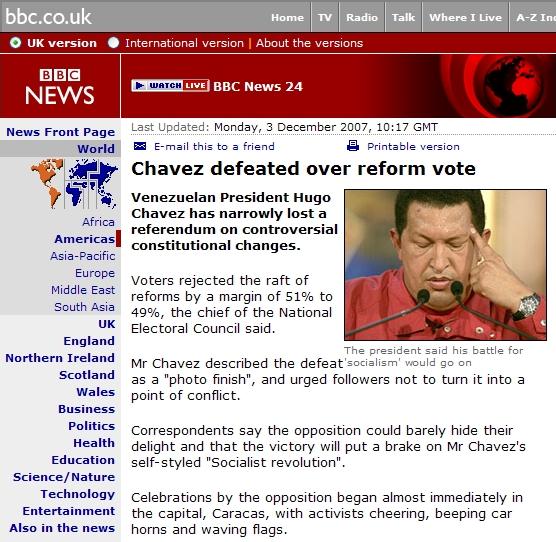
Venezuela and the Referendum - BBC Just Not Right-Wing Enough

So, there we have it, Hugo Chavez did not win the referendum for his constitutional reforms. The world has not ended. Chavez has accepted the results of the vote with good grace. Still, there is plenty for the mainstream media to crow about, and one of the culprits has the dubious pleasure of being both hyper-critical of Hugo Chavez (see here) as well as being perceived as a left-wing organisation. Strange times indeed. So let's take a look at the output on Venezuela by this fabled left-wing institution shall we?


So far, so innocuous. But it is when examining the detail that the true message shines through like a beacon. Not much further down comes the first telling quote:


Yes, somehow those words are a direct reference to his attempted coup aren't they? I'm not sure why this is particularly relevant. Yes they failed, yes he is obviously going to present it to the public again at some point in the near future. But the question remains, why refer to a coup attempt 15 years ago? Then it gets worse:


The inference clearing being that, through this referendum (and therein lies the key - a referendum), Chavez was aiming to establish a dictatorship. This is on the basis that he wanted to stand an unlimited number of times for President, a bit like the UK. And it also refers to the oft-repeated claims about him being in power until 2050 (more on that later).

Then, in case you didn't get the point drummed into you:


Have you got it yet?? Chavez=dictatorship according to this 'left-wing' media outlet. So there we go, the BBC recipe for a left-wing viewpoint. Sprinkle liberally with references to dictatorships and militant tendencies and allow to stand. Brilliant. These guys must be immensely clever to hide a left-wing ideology in their writings. Either that, or there are a lot of very dim-witted people out there - you decide.


But it's not just the BBC, oh no. The Guardian have let a couple of things slip over this issue. Take this reference on their website:


There's that 2050 reference again, hinting at the possibility of a Castro style dictatorship. Mmmm. This whole 2050 thing was purely hypothetical. It creates the impression that Chavez would hang on to power until 2050 when the reality is that, if Chavez were to stand for every election, he would rely on the will of the people. He has never indicated that elections would be abolished and he would remain in power until 2050. It was an entirely hypothetical proposition.

As for The Guardian, they could have chosen to headline the fact that Chavez gave people the right to vote on such an amendment, true democracy in action. But then this is something we are hardly likely to see encouraged in the UK and the US. People having their say?? What a terrible notion. They also referenced Manuel Rosales (a man who supported the US backed coup) in their paper, but wisely edited it out of the online version.

And what is the situation in Venezuela? Well, Chavez has accepted the result and told his supporters to respect the outcome. Hardly the sign of a power mad totalitarian dictator is it? No matter what the media might have you believe.

Friday, November 30, 2007

Venezuela - The Truth Behind the Spin

With the upcoming referendum in Venezuela, there has been the usual talk of opposition to Hugo Chavez. The Guardian had a short taster (sadly this 'taster' is not available on the website, so you will have to take my word for it) on the front page yesterday insinuating that Chavez was attempting to stay in power until 2030, when all he is proposing is the exact same rules that apply to our Prime Minister ie he can stand for election as many times as he likes. The BBC has also weighed into the debate (remember the BBC described Chavez as a 'militant') with their latest piece about the opposition movement to Chavez:

Hundreds of thousands of Venezuelans have protested against changes to the constitution proposed by the president.

Venezuelans are due to vote on the proposals - which include the removal of presidential term limits - in a referendum on Sunday.

Critics accuse President Hugo Chavez of a power grab, but supporters say the changes will deepen democracy.

It is the latest in a series of student-led rallies, ahead of the "yes" campaign's final march on Friday.

However, correspondents say the "no" campaign is gaining force.

No official crowd estimates were available but an opposition politician put the figure at about 160,000.


Talking up the opposition there. Of course, what the BBC (and other media outlets) fail to recognise is the situation behind the scenes. Luckily, bloggers like RickB at Ten Percent do their job for them. This from his blog [original source]:

On November 26, 2007 the Venezuelan government broadcast and circulated a confidential memo from the US embassy to the CIA which is devastatingly revealing of US clandestine operations and which will influence the referendum this Sunday… The memo sent by an embassy official, Michael Middleton Steere, was addressed to the head of the CIA, Michael Hayden. The memo was entitled ‘Advancing to the Last Phase of Operation Pincer’…

The US operatives emphasized their capacity to recruit former Chavez supporters among the social democrats (PODEMOS) and the former Minister of Defense Baduel, claiming to have reduced the ‘yes’ vote by 6% from its original margin. Nevertheless the Embassy operatives concede that they have reached their ceiling, recognizing they cannot defeat the amendments via the electoral route. The memo then recommends that Operation Pincer (OP) [Operación Tenaza] be operationalized. OP involves a two-pronged strategy of impeding the referendum, rejecting the outcome at the same time as calling for a ‘no’ vote. The run up to the referendum includes running phony polls, attacking electoral officials and running propaganda through the private media accusing the government of fraud and calling for a ‘no’ vote.

The ultimate objective of ‘Operation Pincer’ is to seize a territorial or institutional base with the ‘massive support’ of the defeated electoral minority within three or four days (before or after the elections – is not clear. JP) backed by an uprising by oppositionist military officers principally in the National Guard. The Embassy operative concede that the military plotters have run into serous problems as key intelligence operatives were detected, stores of arms were decommissioned and several plotters are under tight surveillance.

The key and most dangerous threats to democracy raised by the Embassy memo point to their success in mobilizing the private university students (backed by top administrators) to attack key government buildings including the Presidential Palace, Supreme Court and the National Electoral Council. The Embassy is especially praiseworthy of the ex-Maoist ‘Red Flag’ group for its violent street fighting activity.


So, it looks like there will be yet another attempt to instigate a coup in Venezuela. This time the claims of a power grab will be used as the pretext and the media are happy to play along. No doubt we will see a repeat of the footage that was broadcast during the last coup attempt that suggested that supporters of Chavez were firing onto groups of protesters. The truth is that the US is eager to find a way to oust Chavez due to his rising influence in the region. What scares them more than anything else is that a successful alternative to US imperialist capitalism might take hold in the Southern hemisphere and spread across the globe. One hopes that this proves to be the case.

Sunday, September 02, 2007

Wall Street Journal Attacks Chavez With Disinformation and Propaganda

The Wall Street Journal has launched yet another tirade of propaganda about the leadership of Hugo Chávez in Venezuela. The latest attack on Chávez comes in the form of a review of a couple of books that are being published on the populist leader. Here are a few choice extracts from their 'review' [I have added some comments in brackets and underlined particularly dubious claims]:

On April 11, 2002, at least 500,000 protesters took to the streets to push back. When Mr. Chávez ordered the military to use force against them, the officer corps refused, and Mr. Chávez was unseated [no comment on US involvement]. But he still had ideological allies inside the military working to outmaneuver his enemies, and the chavista machine soon called its own protesters to the streets. Two days later he was restored to power, though few know exactly how it happened. Today his government is ever more authoritarian, seizing major assets (in May he took over Venezuela's last privately held oil fields), revoking the license of important opposition media and tamping down political opposition by threatening the employment of those who oppose him. More and more, Mr. Chávez's Venezuela resembles Perón's Argentina -- if not the China of Mao, whom Mr. Chávez once so admired.

One of the great frustrations of President Chávez's adversaries has been his skillful use of the law -- under the guise of democracy -- to thwart his opposition.


Graft is worse than ever, and Mr. Chávez himself, who has destroyed nearly all institutional checks on his power, says that he won't step down from the presidency until 2030 [Chávez has made no such claim. In fact, he has simply stated that if the opposition fail to put up a candidate, he would decree a referendum to enable him to remove term limits and thus allow him to run again for office. Effectively, this could mean that he would remain in office until 2030, but he would have to elected for this to happen. Why this is so contentious is rather bizarre. A British Prime Minister can stay in office as long as they receive enough public support. There is no term limit.].

More worrisome still, Mr. Chávez has used his country's oil wealth to engage in a weapons buildup and to fund subversion in neighboring Latin American countries [military expenditure under Chavez is actually lower than it was under pre-Chavez Venezuela]. His public rhetoric -- notoriously on display at the United Nations in September 2006 -- is provocatively anti-American. He has made friends with the "axis of evil," cozying up to Iran and North Korea on both the political and the economic front [These relationships are often mentioned by anti-Chavez campaigners. I have to admit, I am a little uncomfortable with his ties to Iran. However, the relationship with Iran is part of an effort to ensure Venezuela continues to command high oil prices and thus ensure the continuation of the programmes to help the poor. Essentially, the Iranian role is give technological assistance to the Venezuelan oil industry. It takes a rather different stance on Israel than Iran. In fact, Venezeula has had strong trading ties with Israel over recent years, at least until the US put an end to this relationship. As for North Korea, Venezuela openly condemned the nuclear test performed by the dictatorship]. Not surprisingly, he has garnered more attention from the U.S. than any Latin leader since Daniel Ortega and the days of Soviet meddling in Nicaragua.

Whatever else Hugo Chávez may be, he is the product of his country's troubled recent history. For more than two decades before he came to power, Venezuela's oil wealth was in the hands of the state. As such, it was a corrupting force, channeling money and power to political favorites and corrupt oligarchs. Little surprise, then, that Venezuela's democracy collapsed under such an arrangement and that an egomaniacal military officer schooled in communist ideology stepped into the breach. Whether Mr. Chávez's opponents, since then, have learned anything about the importance of limited government remains to be seen.

Another classic example of Western liberal media attacking a democratically elected government that dares to challenge the status quo. When the leading capitalist press is eager to spread lies and disinformation about Chávez, you know that he must be doing something right. The irony is, of course, that the Wall Street Journal has previously stood up for a real dictator, Musharraf of Pakistan. Clearly, Musharraf is a 'good dictator', compliant to America's wishes and therefore a friend of the capitalist establishment. Chávez's crime is that he is not compliant and has made enemies amongst the capitalist establishment. No wonder the Wall Street Journal is so scared.

Tuesday, July 17, 2007

Venezuela on Brink of Civil War

That's the claim in the latest issue of the New Statesman. In an entirely one-sided article, Alice O'Keeffe claims that the very fabric of Venezuealan society is falling apart at the seams. In one paragraph, O'Keefe examines the 'typical symptoms' of a country heading towards a civil war:

William Ury, a conflict resolution expert at Harvard, identifies three typical symptoms of a country on the brink of civil war. The first is that the population begins to arm itself; the second is that each side begins to dehumanise and impute evil intentions to the other; and the third is the politicisation of the media. Contemporary Venezuela has each of these conditions in abundance. Ury suggests that the key to defusing the threat is to strengthen the "third side": those organisations or people who empathise with both sides of the conflict and will encourage others to resolve their differences non-violently.

The author leaves the reader in no doubt about her views when she 'examines' the revocation of RCTV's licence. In two passages she gives the game away entirely:

the recently closed anti-Chávez television station Radio Caracas Televisión (RCTV)

and

the government shut down RCTV

As most informed people are only too aware, RCTV was not shut down. In actual fact, it's licence to broadcast as a terrestrial channel was revoked. It can, however, continue to broadcast via satellite and cable. To claim that this is equivalent to 'shutting it down' is at best disingenuous and at worst inflammatory. This lie has been spread ad nauseum via the mainstream media in a blatant attempt to destabilise a country that has dared to take the path dictated to by the West. That a supposedly left-wing publication can perpetuate such a lie is a truly worrying sign of how far some on the left have veered to the right.

Furthermore, O'Keefe seems willing to overlook the role RCTV played in the 2002 coup. She writes:

The charges against it were of anti-government bias, in particular its refusal to air news of the pro-Chávez protests that brought him back to power after the 2002 coup.

This seems to rather downplay the role that RCTV played in the coup. It was RCTV who showed footage that claimed that Chavez supporters were firing on civilians during the US backed coup. The reality was that footage was manipulated by RCTV to make it look like they were firing on unarmed protesters. RCTV's role in the coup was so significant, the news director of the time had to resign when RCTV and other networks decided to censor the civil uprising aimed at restoring democratically elected Chavez after the coup d'etat. RCTV's role in proceedings isn't even mentioned in the article.

What is even more intriguing is O'Keefe's defence of RCTV. Early in the article, she claims that:

....RCTV was predominantly an entertainment channel, and showed some of the nation's favourite soap operas, or "novelas".

You would deduce from this that RCTV's news coverage was pretty minor compared to its 'entertainment' output. However, O'Keefe then goes on to quote a student who was opposed to the shut down:

"When they closed RCTV, we really got desperate, and furious about the lack of freedom of expression and diversity of thought," she said. "We realised we could not let it carry on. It is not like the president says - I'm not from the elite; my family doesn't even own a house. I just can't see this happen to my country."

How can the revocation of a licence for a network whose main output is 'soap operas' possibly have an impact on 'diversity of thought'? The two things don't add up. Either it is an entertainment channel providing harmless 'novelas', or it is a vital voice of diversity. If O'Keefe is so willing to dismiss RCTV as an entertainment channel (and so question why Chavez took the action he took), why are student protesters claiming it was a source of diversity? Perhaps because this is nothing more than a put-up job to appease the establishment. After all, she did title the piece:

Chávez: From hero to tyrant.

For sometime I have toyed with the idea of a subscription to the New Statesman, mainly due to the odd article by Pilger or Chomsky. On the basis of this evidence, I think I will give it a miss.

Sunday, June 17, 2007

US Cosies Up To Musharraf and Attacks Chavez

An interesting difference in the attitude of the US government to Venezuela and Chavez in the light of the recent controversies surrounding the media in the respective countries. First, we have John Negroponte, the man who sent the orders for Saddam to be executed (he flew into Iraq for secret talks two days before Saddam was sentenced - coincidence?), and his warm words for President Musharraf.

John Negroponte, the US deputy secretary of state, has backed General Pervez Musharraf, saying it was up to the Pakistan president to decide when to quit as army chief.

Negroponte held talks with Musharraf on Saturday amid a tense political crisis over the suspension of Pakistan's chief justice.

Negroponte said at the US embassy in Islamabad: "The message I brought was one of a strong friendship and trust for and with the government and people of Pakistan."

Those opposing Musharraf have seized on the unrest to press the president to give up his dual role as president and head of the military by the end of the year, when he is constitutionally obliged to.

When asked if he had talked with Musharraf about the removal of Iftikhar Chaudhry, the Pakistan supreme court chief justice, Negroponte said he had discussed the "general political situation" in Pakistan.

Critics accuse Musharraf of suspending Chaudhry to remove obstacles to his re-election as president-in-uniform by the outgoing parliament, in defiance of the Pakistani constitution.


"I think this is something that President Musharraf himself is going to want to decide and this is a matter that is up to him," Negroponte said.


No condemnation for the recent attack on Pakistan's media, merely words of support and 'friendship'. Compare this to the latest attack on Chavez by the Bu$hleaguers:

Robert Zoellick, almost certain to be the next head of the World Bank, on Saturday took aim at Venezuela's leftist president, Hugo Chavez, warning that his oil-fueled socialist revolution was headed for trouble.

"It's a country where economic problems are mounting, and as we're seeing also on the political and press side it's not moving in a healthy direction," Zoellick told reporters during a visit to Mexico.

So Pakistan, a country whose police raided the offices of a critical media network and shut it down, is worthy of 'strong friendship and trust', while Venezuela, a country that refused to renew the licence of a channel that was heavily involved in the failed 2002 coup, is 'not moving in a healthy direction'. An interesting interpretation of events, I'm sure you will agree.

Thursday, June 14, 2007

Media Lens Exposes Media Frenzy Over Chavez

Media Lens has a very interesting alert regarding the feeding frenzy over RCTV's licence. Central to the argument is the repeated doubt cast over RCTV's role in the 2002 coup. According to the alert:

A consistent theme of media reporting has been to ascribe this "accusation" to Chavez personally. Thus the Independent wrote of the “station, which Mr Chavez believes was plotting against him”. (‘Anti-Chavez protesters clash with police,’ The Independent, May 29, 2007)

The Times reported: “President Chavez withdrew its licence, accusing the network of ‘coup plotting‘”. (Philp, op. cit)

Likewise the Financial Times: “Chavez has repeatedly alleged that it supported the [2002] coup...” (Richard Lapper, ‘TV channel axed in latest Chavez drama,’ Financial Times, May 26, 2007)

And the BBC: “He [Chavez] says they were involved in a coup that nearly toppled him five years ago.” (James Ingham, ‘Venezuelans protest over TV issue,’ BBC Online, May 27, 2007; http://news.bbc.co.uk/go/pr/ fr/-/1/hi/world/americas/6695769.stm)

These media reports thus all distort the truth by attributing a mere “claim” to Chavez, someone they have all previously demonised as an authoritarian “strongman”. This earlier demonisation acts to undermine the credibility of the charge against RCTV in readers’ minds, so reinforcing the bias of ostensibly balanced reporting against the Venezuelan government. Robert McChesney and Mark Weisbrot explain:

“This is a common means of distorting the news: a fact is reported as accusation, and then attributed to a source that the press has done everything to discredit.” (McChesney and Weisbrot, ‘Venezuela and the Media: Fact and Fiction,’ Common Dreams, June 1, 2007; http://www.commondreams.org/ archive/2007/06/01/1607/)

Read the full alert here.

Friday, June 01, 2007

RCTV - Why It Was Right To Close It Down

An excellent piece in the LA Times (unusual for a Western media outlet) explaining why RCTV had to have its licence revoked:

RCTV's most infamous effort to topple Chavez came during the April 11, 2002, coup attempt against him. For two days before the putsch, RCTV preempted regular programming and ran wall-to-wall coverage of a general strike aimed at ousting Chavez. A stream of commentators spewed nonstop vitriolic attacks against him — while permitting no response from the government.

Then RCTV ran nonstop ads encouraging people to attend a march on April 11 aimed at toppling Chavez and broadcast blanket coverage of the event. When the march ended in violence, RCTV and Globovision ran manipulated video blaming Chavez supporters for scores of deaths and injuries.

After military rebels overthrew Chavez and he disappeared from public view for two days, RCTV's biased coverage edged fully into sedition. Thousands of Chavez supporters took to the streets to demand his return, but none of that appeared on RCTV or other television stations. RCTV News Director Andres Izarra later testified at National Assembly hearings on the coup attempt that he received an order from superiors at the station: "Zero pro-Chavez, nothing related to Chavez or his supporters…. The idea was to create a climate of transition and to start to promote the dawn of a new country." While the streets of Caracas burned with rage, RCTV ran cartoons, soap operas and old movies such as "Pretty Woman." On April 13, 2002, Granier and other media moguls met in the Miraflores palace to pledge support to the country's coup-installed dictator, Pedro Carmona, who had eliminated the Supreme Court, the National Assembly and the Constitution.


Despite the facts behind the revocation of the licence (RCTV can continue to broadcast, the licence merely stops their terrestrial output), lies are still being spread about the nature of the action taken by Chavez. Perhaps the biggest slur on Chavez has been the alleged murder of Andreina Gomez Guevara. According to one media outlet:

At approximately 3:20 p.m. this afternoon in Caracas security forces murdered a Venezuelan student who was taking part in the ongoing peaceful protests against Hugo Chavez's regime, eyewitnesses said.

The student who was killed was named Andreina Gomez Guevara. She was 24 years old and attended UCAB, the Catholic University of Venezuela.

Students inside Venezuela are using the Internet to try to get out news about this murder and these demonstrations to the outside world. They complain that media inside Venezuela has either been silenced or intimidated, preventing a true picture of events there from being reported, and they appeal for help.


Of course, it goes without saying that this is a deeply troubling development if it is true. However, as with so much of the media's reporting of events in Venezuela, it seems unlikely to be accurate. According to another media source:

[ Justice Minister Pedro] Carreno told state-run TV that two suspects were arrested in connection with the killing of a student from the Andres Bello Catholic University who had taken part in the protests. Andreina Gomez Guevara, 24, was shot three times at a gasoline station in Caracas by hired gunmen, Carreno said.

The university issued a statement condemning the shooting, but said it believed the case was unrelated to Gomez Guevara's participation in the protests.


And another:

There have been dozens of injuries and arrests from clashes with police. On Thursday, in an incident which as of yet has not been connected to the clashes, a university student who had taken part in the protests was shot three times and killed at a gasoline station in Caracas.

Two suspects have been arrested for the shooting of Andreina Gomez Guevara, 24, according to Justice Minister Pedro Carreno. The two attackers - a man and a woman - allegedly confessed to killing Gomez Guevara from a motorcycle in exchange for some 4,600 dollars.

The Andres Bello Catholic University condemned the shooting, but said the killing of Gomez Guevara was unrelated to her participation in the protests.

Interestingly, the talk of bullets being fired into the crowd sounds reminiscent of the 2002 coup which RCTV were heavily implicated in. The truth is that the media have spun this beyond any recognition of the reality. The suggestion by one media outlet that the government was responsible for the murder of a demonstrator is yet another example of quite how far some will go to discredit Chavez's revolution in Venezuela. Facts will continue to be lost in the race to condemn a leader who is prepared to stand up for the poor in the face of increasing hostility from the rich.

* A commenter from Biased BBC (they are good for something, if inadvertently) kindly helped me to find this clip from The Onion which could equally be applied to Venezuela:

Wednesday, May 30, 2007

BBC Stealth Edits Venezuela Piece

Interestingly, the BBC have stealthily edited their coverage of the revoking of RCTV's licence. Originally it claimed that:


Mr Chavez has warned his followers that the country is under threat from those opposed to his militant rule.


It now reads:


Mr Chavez has warned his followers that the country is under threat from those opposed to his rule.


Too little too late. The BBC, as with other mainstream media, has been quick to jump on a supposed militant undercurrent in Venezuela as part of the efforts of the West to undermine Chavez's anti-capitalist policies. No doubt there will be more examples to come.

Saturday, May 26, 2007

BBC Defending the Capitalist Status Quo

Well, the BBC has shown that where Fox leads, they will follow. I could not believe my eyes when I read this piece on their website today. I was so shocked I had to take a screen shot just in case they altered it:


Militant rule? Now there is a loaded phrase. I wonder how else the BBC uses such terminology? How about here, here, here and here? Mmmm, I do hope the BBC isn't being pressured into accepting the sequence of events suggested by our government and the United States. The article itself barely mentions the role RCTV played in the 2002 coup. So much for impartiality.

Weblog Commenting and Trackback by HaloScan.com